
A Go-to-Market strategy is your plan for turning your validated business model into actual revenue. It’s the system that explains how you’ll reach customers, convince them to buy, and deliver your solution in a way that actually works.
Think of it as the execution layer of your business. You might have a clear value proposition, a solid business model, and real customer validation, but without a concrete GTM strategy, you’re still just theorizing. GTM is where theory meets reality.
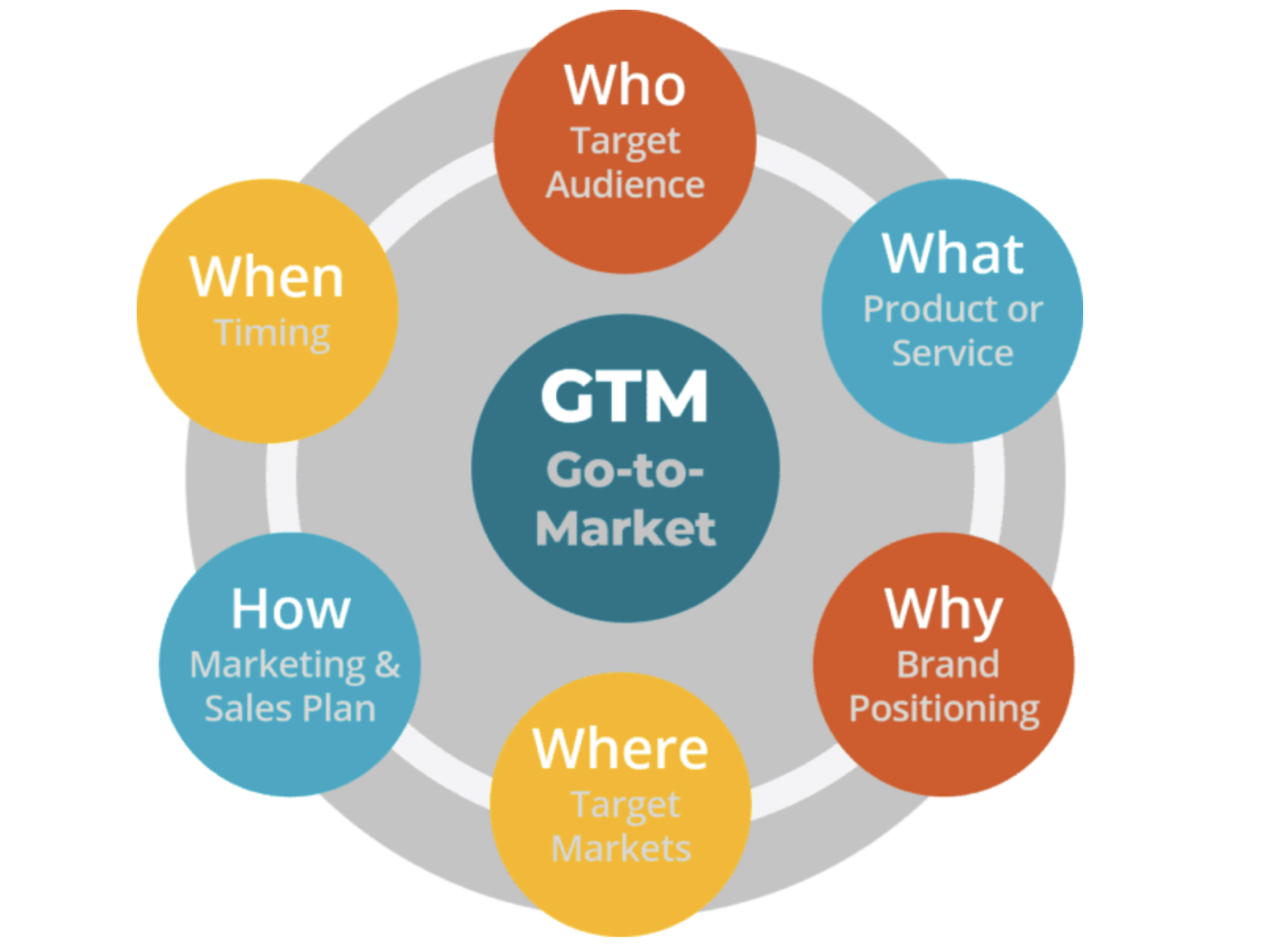
The Foundation
Every GTM strategy answers one fundamental question: How do you actually acquire your first customers and turn them into paying users?
This sounds straightforward, but it’s where most validated startups still fail. They’ve proven people want their solution, they understand their business model, but they can’t figure out how to consistently reach the right people and convert them efficiently.
Take Slack as an example. Their GTM strategy wasn’t “we’ll advertise team communication software.” Their strategy was bottom-up adoption: get individual teams using it for free, let them experience the value, then convert entire organizations through internal advocacy. That specific approach - free team usage leading to company-wide adoption - is what made them successful where dozens of enterprise communication tools had failed.
The Three Core Components
Every GTM strategy has three essential elements working together:
Market Positioning - How do you position yourself in the customer’s mind relative to alternatives? This isn’t your value proposition - it’s how you frame that value proposition against what customers already know. Do you position as “the simple alternative to complex enterprise software” or “the professional upgrade from free consumer tools”? Your positioning determines who pays attention and how they evaluate you.
Pricing Strategy - What exactly will customers pay, how will they pay it, and what do they get in return? You roughed this out in your business model, but now you need the specifics. Monthly subscription or annual upfront? Free trial or freemium model? One price for everyone or tiered packages? These choices fundamentally shape your customer acquisition approach.
Channel Strategy - How will customers actually discover you, evaluate you, and buy from you? Through direct sales conversations, self-service signups, partner referrals, or product-led growth? Your channel choice affects everything from your messaging to your cost structure to how fast you can scale.
Why GTM Comes After Business Modeling
You’ve spent weeks validating your problem, defining your value proposition, and mapping your business model. So why didn’t we talk about GTM earlier?
Because you weren’t ready yet.
Before you can execute a GTM strategy, you needed clarity on:
- Your specific customer segments and their pain points
- Your value proposition and what makes it compelling
- Your cost structure and unit economics
- Your revenue model and rough pricing
- Your key resources and partnerships
These aren’t just boxes you checked - they’re the foundation your GTM strategy builds on.
If your customer acquisition cost can’t exceed 500 SEK but your average sale is 300 SEK, you can’t afford high-touch sales. If your target customer is a busy CEO, cold calling won’t work - they have gatekeepers. If your solution requires technical integration, you need a hands-on sales process, not just a signup button.
Your business model defines the constraints. Your GTM strategy finds the path to success within those constraints.
Getting Concrete: Positioning and Messaging
Positioning is how you occupy mental real estate in your customer’s mind. It’s not what you say about yourself - it’s where you fit in the landscape of solutions they already understand.
Consider how Zoom positioned themselves when they launched. The video conferencing market was crowded. Skype, WebEx, and GoToMeeting all existed. Zoom didn’t say “we do video calls better.” They positioned as “video conferencing that just works” - explicitly positioning against the frustration everyone experienced with existing tools.
That positioning decision shaped everything:
- Their messaging emphasized reliability over features
- Their pricing was simple and transparent (unlike competitors)
- Their target was individual teams, not IT departments
- Their channel was bottom-up adoption, not enterprise sales
Your positioning should answer:
What’s the main alternative customers compare you to? Not all competitors - the one thing they’ll do if they don’t choose you. This might be a specific competitor, a manual process, or simply doing nothing.
What’s your key differentiator on axes customers care about? Don’t list everything you do differently. Pick the one or two dimensions that actually matter for customer decisions. Is it price vs features? Simplicity vs power? Speed vs thoroughness?
What category do you fit in? Customers think in categories. If you’re creating something new, what existing category is it most like? Being “totally unique” sounds good but makes you harder to understand and buy.
Once your positioning is clear, messaging flows from it. Your messaging is how you communicate that positioning across different contexts:
- Your homepage headline
- Your cold email opening line
- Your first sales call explanation
- Your LinkedIn post about what you do
All of these should reflect consistent positioning while adapting to the specific context.
Pricing Strategy: Getting Specific
You set a rough price when you built your business model. Now you need to make detailed decisions that determine whether customers actually buy.
Pricing isn’t just a number - it’s a signal about who you’re for and what kind of solution you are.
The Pricing Model Decision
Subscription pricing (monthly or annual recurring revenue) creates predictable cash flow and aligns your success with customer success. But it requires customers to commit to ongoing payments before they’ve fully experienced your value.
Transaction pricing (take a percentage of each transaction) aligns your revenue directly with customer activity. But it makes your income variable and harder to forecast.
One-time pricing (pay once, own forever) is psychologically easier for some customers. But it front-loads your revenue and makes ongoing development harder to fund.
Freemium (free basic version, paid premium) reduces barriers to trying your product. But it means most users never pay, and you need very efficient conversion mechanisms.
The right model depends on your specific situation:
- How quickly can customers experience value?
- How often do they need your solution?
- What’s their mental model for paying for this type of thing?
- Can you afford to operate while they’re not paying?
The Packaging Decision
Should you have one price or multiple tiers? What goes in the basic package vs premium?
Multiple tiers work when:
- Different customer segments have genuinely different needs
- Some features clearly provide more value than others
- You can create an obvious upgrade path
Single pricing works when:
- Your solution is simple and unified
- Everyone needs basically the same thing
- You want to reduce decision paralysis
Most early startups overcomplicate this. They create three or four tiers with complex feature matrices before they’ve made a single sale. Start simple. You can always add complexity later once you understand how customers actually think about value.
The Price Point Decision
How do you set the actual number?
Three perspectives matter:
Your costs - What’s your floor? What’s the minimum you can charge and still build a sustainable business? This includes both direct costs (what it costs to serve one customer) and indirect costs (development, support, overhead) spread across expected customer volume.
Competitor pricing - What’s the market reality? What do alternatives charge? You don’t have to match them, but you need to understand why you’re different. Being 5x more expensive requires clear justification. Being 10x cheaper raises questions about quality.
Customer value - What’s your ceiling? How much value do you create for customers in terms they care about (time saved, revenue generated, costs reduced, problems eliminated)? Your price should be a fraction of that value - significant enough to be meaningful for you, but small enough that it’s an obvious good deal for them.
The sweet spot is usually somewhere between these three constraints. Price too close to your costs and you have no margin for error or growth. Price too close to the value ceiling and customers feel taken advantage of. Price too far from competitors and you’ll spend all your time explaining why.
For your first pricing, aim for something defensible based on these factors, then test it with real customers. You’ll learn more from actual buying decisions than from any amount of analysis.
Channel Strategy: How Customers Actually Find You
Channel strategy is where most early-stage startups struggle the most. There are dozens of possible ways customers might discover and buy from you, but you have limited time and resources. Which channel do you focus on?
Here’s the reality: you need to pick one primary channel and commit to making it work before you spread to others.
The Channel Options
Direct sales (high-touch) - You reach out to potential customers directly, have conversations, give demos, negotiate, and close deals personally. This works when:
- Your average deal size is large enough to justify the effort (typically >50,000 SEK annual value)
- Your solution requires explanation or customization
- Your target customers expect personal attention
- You’re still learning what messages and approaches work
Self-service (low-touch) - Customers discover you (through search, ads, referrals), evaluate you through your website, and sign up without talking to anyone. This works when:
- Your solution is simple enough to understand and buy without help
- Your price point is low enough that customers don’t need approval or negotiation
- You can create clear, compelling digital content that converts
- You have efficient onboarding that gets people to value quickly
Product-led growth - Customers start using a free or trial version, experience value directly, and then convert themselves to paying users. This works when:
- Your product’s value is immediately obvious through use
- You have viral or network effects (value increases when others use it)
- The free version is valuable enough to use but limited enough to encourage upgrades
- Your unit economics support giving away significant value for free
Partner channels - You work with other companies (resellers, integrators, consultants) who introduce you to their customers. This works when:
- Your solution complements something customers already buy
- Partners have established relationships with your target customers
- You can enable partners to successfully sell your solution
- You’re willing to share revenue and control in exchange for access
Making the Channel Decision
Don’t choose based on what sounds good or what successful companies do. Choose based on:
Your customer’s buying behavior - How do they currently find and evaluate solutions like yours? If your target customer is a CFO, they’re not scrolling social media looking for software. They’re asking their network for recommendations. If your target is a freelancer, they’re probably searching Google and reading reviews.
Your price point and deal size - If you’re charging 99 SEK/month, you cannot afford sales calls and personal demos. The math simply doesn’t work. If you’re charging 100,000 SEK/year, you probably can’t rely on people just stumbling across your website and self-serving.
Your current stage - In your first 3-6 months, favor channels that give you fast feedback and direct customer contact. You need to learn what messages work, what objections come up, and how customers actually think about your solution. Channels like direct outreach and sales calls give you this. Channels like content marketing and SEO take months to generate data.
Your actual capabilities - Don’t pick “content marketing” if you hate writing or can’t commit to publishing consistently. Don’t pick “cold calling” if you can’t handle rejection. Don’t pick “product-led growth” if your product requires configuration to deliver value. Pick something you can actually execute well.
For most early-stage B2B startups, the answer is some form of direct outreach:
- Identifying specific target companies or people
- Reaching out personally via email, LinkedIn, or phone
- Having conversations to understand their situation
- Demonstrating value through customized explanations
- Closing deals through personal relationship
This doesn’t scale elegantly, but it works for getting your first 10-50 customers. And more importantly, it teaches you everything you need to know to eventually build more scalable channels.
Goals and Metrics: What Success Looks Like
A GTM strategy without clear goals and metrics is just a list of activities. You need to know what you’re aiming for and how you’ll measure progress.
The Goals That Matter Early
For your first GTM push, focus on a small number of concrete goals:
Number of customers - How many paying customers do you want in the next 3 months? Make it ambitious but achievable. For most early startups, 10-30 customers is a reasonable initial goal.
Revenue - How much recurring revenue do you want to reach? This matters more than total customers because it accounts for the value of each customer.
Customer acquisition cost (CAC) - How much are you spending (in money and time) to acquire each customer? You need to track this from day one because it determines what channels can work as you scale.
Time to first value - How long does it take from first conversation to customer experiencing value? The shorter this is, the easier every part of your GTM becomes.
The Metrics That Guide Decisions
Track these numbers weekly:
- Outreach volume - How many potential customers are you contacting?
- Response rate - What percentage respond to your outreach?
- Conversation rate - How many responses turn into actual sales conversations?
- Conversion rate - What percentage of conversations result in purchases?
- Average deal size - How much does each customer pay you?
- Onboarding completion - How many new customers actually start using your solution?
These metrics tell you where your GTM is breaking down.
Low response rate? Your targeting or messaging is off. High response but low conversation rate? You’re not qualifying properly or your follow-up is weak. Good conversations but low conversion? Your pricing might be wrong or your value proposition isn’t landing. High conversion but low onboarding completion? Your solution is harder to implement than expected.
Don’t wait until you have 100 data points to look at metrics. Start tracking from customer one. The patterns emerge faster than you think.
The Common Mistakes
Mistake 1: Planning Instead of Doing
Many founders spend weeks perfecting their GTM strategy before reaching out to a single customer. They obsess over the perfect positioning statement, create elaborate channel plans, and design complex pricing matrices.
This is procrastination disguised as preparation.
Your first GTM efforts will be messy. Your positioning will evolve as you talk to customers. Your channel choice will change based on what actually works. Your pricing will adjust based on real reactions.
The goal of early GTM is not to create the perfect scalable machine. It’s to make sales and learn from them. You learn infinitely more from one sales conversation than from another week of planning.
Build a simple GTM plan (one page is enough), then start executing. Adjust based on what you learn.
Mistake 2: Trying Multiple Channels Simultaneously
You see other companies succeeding with content marketing, so you start a blog. You hear cold email works, so you build a list. You think LinkedIn might be good, so you start posting. You try a bit of everything and commit to nothing.
The result: you do all of them poorly and learn nothing useful. Each channel requires different skills, content, and time to show results. Spreading your effort across five channels means you can’t execute any of them well enough to know if they work.
Pick one channel. Give it your full focus for at least 6-8 weeks. Track clear metrics. Get conclusive data on whether it works for you. Then either double down or move to a different channel.
Most successful startups found one channel that worked, exhausted it, then expanded to a second channel. They didn’t succeed by doing ten things halfway.
Mistake 3: Ignoring Unit Economics
Your channel might generate customers, but are those customers profitable?
If your customer acquisition cost (including your time) is 5,000 SEK and your customer lifetime value is 6,000 SEK, you don’t have a sustainable business. You have a machine that converts money into slightly more money very slowly.
Track your CAC from day one. Include everything: your time, any tools you pay for, any ads you run. Be honest about what it actually costs to acquire each customer.
If your CAC is too high relative to your customer value, you need to either:
- Increase prices
- Decrease acquisition costs (find a cheaper channel)
- Increase customer lifetime value (reduce churn, add upgrades)
- Accept that this channel won’t work and try something else
Many startups ignore this until they’ve spent months on a channel that can never work economically. Don’t be one of them.
Mistake 4: Optimizing Before Validating
You make your first few sales through personal outreach. It’s working. So you immediately start thinking about how to automate it, scale it, make it more efficient.
You build email sequences, create fancy landing pages, and set up complex tracking systems before you’ve even proven the basic model works consistently.
This is premature optimization.
First, prove you can consistently make sales using a manual, unscalable process. Get to 10 customers, then 20, then 30. Understand deeply what makes them buy and what makes them stick around.
Then, and only then, start thinking about how to make the process more efficient and scalable.
The early inefficiency is where you learn. Don’t optimize it away before you’ve learned what you need to know.