
Lean Canvas is an adaptation of the Business Model Canvas specifically designed for startups working under extreme uncertainty. Developed by Ash Maurya, this tool focuses on what matters most when you’re just starting: identifying your riskiest assumptions and testing them systematically.
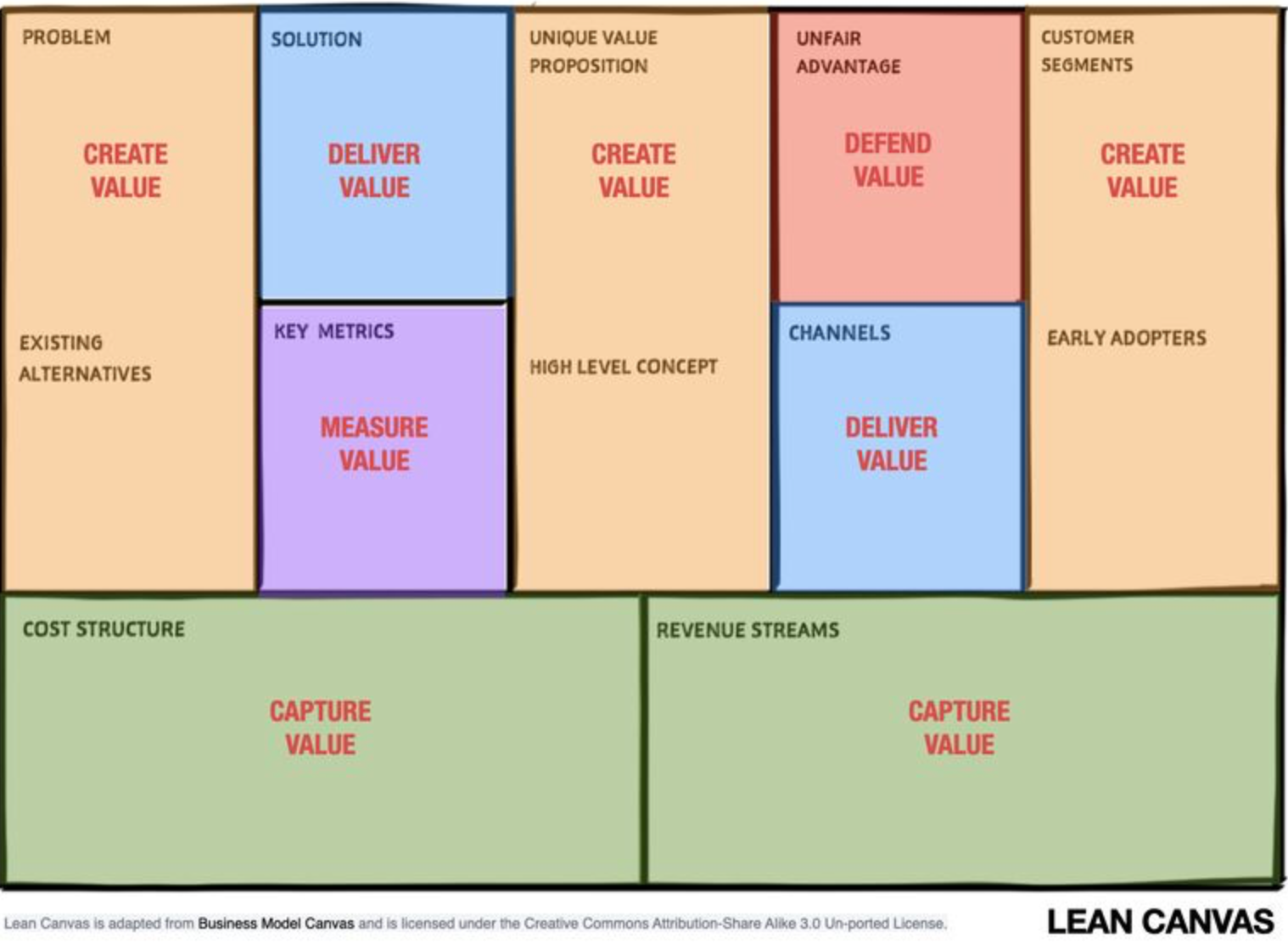
While the Business Model Canvas gives you a complete picture of your business, Lean Canvas is built for speed and iteration. It replaces four blocks with startup-focused elements: Problem, Solution, Key Metrics, and Unfair Advantage. This makes it faster to fill out and more useful for identifying what you need to test first.
When to Use Lean Canvas vs Business Model Canvas
Use Lean Canvas when:
- Everything about your business model is uncertain
- You need to identify your riskiest assumptions quickly
- You’re iterating rapidly and need a tool you can update weekly
- You’re in the very early stages and don’t have customers yet
- You want to focus on problem-solution fit before building
Use Business Model Canvas when:
- You’ve validated your basic value proposition
- You need to see how all pieces of your business connect
- You’re planning for scale and sustainability
- You’re communicating with investors or partners who expect the standard framework
- You’ve moved beyond testing assumptions to executing a proven model
Use both: Start with Lean Canvas to identify and test your riskiest assumptions. Once you’ve validated problem-solution fit and early traction, expand to Business Model Canvas to design your complete business system.
The Nine Building Blocks
Lean Canvas has nine sections. Five are the same as Business Model Canvas (Customer Segments, Channels, Revenue Streams, Cost Structure, and Value Propositions). Four are different to focus on startup-specific concerns:
1. Problem
The question: What are the top 1-3 problems your target customers have?
You can’t build a solution until you deeply understand the problem. List the most painful problems your customers experience, then document how they solve these problems today. Existing alternatives reveal what you’re competing against, including “do nothing.”
Be specific. “Small business owners struggle with finances” is too vague. “Small business owners spend 10+ hours monthly on manual bookkeeping and can’t get clear visibility into cash flow” is concrete enough to test.
2. Customer Segments
The question: Who specifically has these problems?
Don’t say “small businesses” or “consumers.” Define your target customers with enough specificity that you can find and talk to them. Include demographics, but also focus on behavior and needs.
Identify your early adopters separately. These are the customers most likely to try your solution first, usually because their pain is most intense or they’re most open to new approaches.
3. Unique Value Proposition
The question: What makes your solution worth paying attention to?
This is your single, clear, compelling message that explains why you’re different and worth trying. Focus on the outcome customers get, not features you build.
A strong UVP tells customers what problem you solve, who you solve it for, and why you’re different from alternatives. It should be understandable in seconds.
4. Solution
The question: What are the top 3 features of your solution?
List only the most critical features that address each problem you identified. Focus on the minimum viable product - what’s the simplest thing that could possibly solve the customer’s problem?
Don’t list every feature you’ll eventually build. List the 3 things that must work for customers to get value. Everything else comes later.
5. Channels
The question: How will you reach your customers?
Channels cover how customers discover you, evaluate your solution, purchase it, receive it, and get support. For early-stage startups, focus on channels that don’t scale but let you learn.
Direct channels (your own website, sales team) give you control but require effort to build. Partner channels (affiliates, resellers) can scale faster but you lose some control and margin.
6. Revenue Streams
The question: How will you make money?
Define your pricing model and key financial metrics. Include your average revenue per customer, how long they typically stay (lifetime value), and your gross margin after direct costs.
For early-stage startups, you might not know these numbers precisely. Make your best estimate and mark it as an assumption to test.
7. Cost Structure
The question: What are your biggest costs?
Focus on the costs required to test and validate your business model. Include both fixed costs (stay constant) and variable costs (change with volume).
Most important: calculate your customer acquisition cost (CAC). How much does it cost to acquire one paying customer? This determines whether your business model can work.
8. Key Metrics
The question: What numbers show whether your business model is working?
Identify the 3-5 metrics that matter most for your business. These should tell you if you’re making progress toward product-market fit and sustainability.
Focus on metrics you can act on, not vanity metrics. “Number of signups” is less useful than “percentage of signups who complete setup and use the product weekly.”
9. Unfair Advantage
The question: What do you have that can’t easily be copied or bought?
This is the hardest section to fill honestly. An unfair advantage is something that gives you a real, sustainable edge over competitors. It’s not “first mover advantage” (easily overcome) or “better execution” (everyone claims this).
Real unfair advantages include: proprietary technology or data, exclusive partnerships, team expertise that’s rare, strong network effects, or brand that can’t be replicated quickly.
If you don’t have one yet, leave it blank. Most early-stage startups don’t. The goal is to build one over time.
How to Use Lean Canvas
Step 1: Fill It Out Fast (30 minutes)
Don’t overthink it. Fill in the canvas in this order:
- Problem
- Customer Segments
- Unique Value Proposition
- Solution
- Channels
- Revenue Streams
- Cost Structure
- Key Metrics
- Unfair Advantage
Use bullet points. Be specific. Document your assumptions as assumptions.
Step 2: Identify Your Riskiest Assumptions
Look at your completed canvas and ask: Which assumptions, if wrong, would make my entire business model fail?
Usually these are in Problem, Customer Segments, or Unique Value Proposition. If customers don’t actually have this problem, or won’t pay to solve it, nothing else matters.
Mark your top 3-5 riskiest assumptions clearly.
Step 3: Design Tests
For each risky assumption, design the smallest, fastest experiment that could validate or invalidate it.
Testing “Do restaurant owners spend 8 hours weekly on manual bookkeeping?” Talk to 10 restaurant owners and ask them to walk through their current process.
Testing “Will they pay 199 USD/month for this?” Show them a landing page with pricing and measure conversion to “request demo.”
Step 4: Run Experiments
Actually do the tests. Talk to real customers. Build simple prototypes. Measure real behavior, not hypothetical interest.
Document what you learn. Be honest about what validates your assumptions and what contradicts them.
Step 5: Update Your Canvas
Based on what you learned, update your Lean Canvas. Change the sections where your assumptions were wrong. If a fundamental assumption fails, you might need to pivot to a completely different customer segment or problem.
Create new versions of your canvas as you learn. Dating them lets you track how your business model evolves.
Differences from Business Model Canvas
Lean Canvas replaces four blocks from Business Model Canvas:
- Problem (replaces Key Partnerships) - Focus on customer problems first
- Solution (replaces Key Activities) - Define your minimum viable solution
- Key Metrics (replaces Key Resources) - Identify what metrics prove your model works
- Unfair Advantage (replaces Customer Relationships) - Define what makes you defensible
These changes make Lean Canvas more focused on the critical uncertainties startups face.
Common Mistakes
Too product-focused: Describing features instead of focusing on customer problems and value. Start with the problem, not your solution.
Too broad customer segment: “Small businesses” or “millennials” aren’t specific enough to find and test with. Get narrow.
Unrealistic unfair advantage: “First mover” or “better execution” aren’t unfair advantages. Be honest about what you actually have that’s hard to copy.
Ignoring existing alternatives: Customers already solve this problem somehow. Understanding how they do it today tells you what you’re competing against.
No validation: Treating the canvas as facts instead of hypotheses to test. Everything on your canvas is an assumption until you validate it with real customers.
Download Template
Download the Lean Canvas template: https://leanstack.com/lean-canvas
You can print it as a large poster and work with sticky notes, or fill it in digitally. The key is making your assumptions visible so you can test them.
What to Bring to Your Workshop
Complete a first draft of your Lean Canvas before coming to Science Park Gotland. Identify your 3-5 riskiest assumptions. Be ready to discuss:
- Which assumptions you’ve already tested and what you learned
- Which assumptions you’re most uncertain about
- What experiments you could run to test them
- Where your canvas feels weakest
We’ll work together to strengthen your canvas, design tests for your riskiest assumptions, and create a validation plan you can execute immediately.
The canvas is meant to evolve. Your first version will be wrong in multiple places. That’s expected. The point is making your assumptions visible so you can test them systematically.
Additional Resources
Books:
- “Running Lean” by Ash Maurya
- “The Lean Startup” by Eric Ries
- “Scaling Lean” by Ash Maurya